
What do you want to learn more about?
Nourished through Treatment™
(Active Treatment Only)
The Signature VIP 1:1


If you’ve typed “how to reduce the risk of cancer” into a search bar, you’re probably one of two people. Maybe you’ve never had cancer, and you want to do what you reasonably can to keep it that way. Or maybe — like me — you’ve already heard the words “you have cancer,” you’ve been through treatment, and the question underneath your question is really: what can I actually control now, so I’m not just waiting for it to come back?
I’m going to write this for both people, because the honest truth is that the science points in largely the same direction either way. The habits that lower a first-time risk are, by and large, the same ones associated with lower risk of recurrence and better survivorship outcomes. So whether you’re here to protect the health you have or to reclaim some agency after a diagnosis, you’re in the right place.
Let me also say this plainly up front, because I know how this topic can land: none of what follows is about blame. If you’ve had cancer, nothing here means you caused it or could have stopped it. Cancer is far more complicated than any single habit, and plenty of it sits outside anyone’s control. What we’re talking about here are the controllables. These are the levers the evidence says are genuinely worth pulling — not a verdict on the past.
A quick note before we dig in: everything in this article is for education, not personal medical advice. Your situation — your history, your treatment, your labs — is yours alone. Please bring anything you read here to your own oncology team and a board-certified oncology dietitian before acting on it. You can read our Website Terms of use here and our Disclaimer here.
Let’s get into it.
Key Takeaways of How to Reduce the Risk of Cancer
- The same levers do double duty. The habits that lower a first-time cancer risk are largely the same ones tied to a lower risk of recurrence. So, this matters whether or not you’ve had cancer.
- A meaningful share of risk is within your control. Roughly 30–50% of cancers worldwide are linked to modifiable factors. And, about 19% of US cases trace to four you can influence going forward: body weight, alcohol, physical activity, and diet.
- Following evidence-based guidelines moves the needle. Closely following the American Cancer Society’s diet and activity guidelines is associated with a 10–20% lower risk of a cancer diagnosis. This is a real shift in the odds, not a guarantee.
- Pattern beats any single food. No food is protective on its own; the benefit comes from your overall eating pattern — held consistently over time. Specifically the patterns of Mediterranean, DASH, or plant-predominant.
- Alcohol carries real risk, but reducing it helps. Alcohol is a Group 1 carcinogen with no known “safe” level. Cutting back lowers risk for at least some cancers.
- Movement counts at any level. Even everyday, non-exercise steps are tied to lower cancer risk — you don’t need an athletic target to benefit.
How Much Cancer Risk Is Actually Within Our Control?
Here’s the number that reframes everything: researchers estimate that roughly 30–50% of cancers worldwide are linked to modifiable factors — the things about how we live that we can actually change as individuals — some in part, some completely.¹
In the United States specifically, when you look at just the four lifestyle levers most of us think of first — body weight, alcohol, physical activity, and diet — the American Cancer Society reports those together were linked to about 19% of cancer cases in 2019.² That’s not the whole modifiable picture (smoking, sun exposure, and certain infections push the actual percentage higher), but the 19% is the slice that nutrition and lifestyle speak to most directly. And it’s a meaningful slice.
The encouraging part isn’t just that these factors matter — it’s that acting on them appears to pay off without requiring a perfect, overhauled life. Adults who most closely follow the American Cancer Society’s diet and activity guidelines have been found to have roughly a 10–20% lower risk of a cancer diagnosis, and an even larger reduction in cancer mortality (or death).² A 2025 meta-analysis pooling fifteen studies demonstrated a 14% lower overall cancer risk with strong adherence to the guidelines.³
I want to be careful here, because this is exactly where a lot of “prevention” content overpromises. These are risk reductions, not guarantees. No food, no habit, no perfect routine makes anyone cancer-proof. But a consistent, evidence-based pattern, held over time, genuinely shifts the odds in your favor — and shifting the odds is worth doing. This is what I mean when I tell my clients to control the controllables.
So let’s walk through the controllables in how to reduce the risk of cancer and those that carry the most weight, one at a time.
Body Weight and Cancer Risk
Of all the lifestyle factors, body weight is one of the most studied — and one of the most misunderstood. Excess body weight is conclusively linked to 13 different cancers, including postmenopausal breast, endometrial (uterine), colorectal, kidney, liver, pancreatic, and several others.² ⁴ In the US, excess weight is behind around 10% of new cancer diagnoses — and for some cancers, like endometrial (uterine) cancer, it plays an even bigger role.⁴
Why does this happen? Excess fat tissue isn’t just storage — it’s metabolically active. Think of it less like a pantry and more like a little factory that’s always running, producing a steady output of insulin, estrogen, and inflammatory signals. Each of those can nudge cells toward the kind of growth we don’t want. That’s the mechanism underneath the statistic.
Here’s the nuance most articles skip, and it matters if you’re going to act on this honestly: the weight-loss evidence comes mostly from observational studies, and it suggests that how much you lose matters — not just whether you lose some. And the amount that appears to move cancer risk may be more than you’d expect.
In the Women’s Health Initiative, women who intentionally lost 5% or more of their body weight had lower rates of obesity-associated and endometrial cancers.⁴ But the Look AHEAD trial — a randomized study, which is stronger evidence — produced about 6.5% average weight loss and did not show a statistically significant drop in obesity-related cancer.⁴ A 2026 JAMA review that looked at all of this together concluded it may take more than 10% weight loss to meaningfully lower cancer risk.⁴
What I take from that — as a dietitian — isn’t “smaller losses are worthless.” Modest weight loss has real benefits for blood sugar, blood pressure, joints, energy, and how you feel day to day. It’s that for the specific outcome of cancer risk, the meaningful threshold appears higher, and the evidence is still catching up. So if weight is a lever you’re working on, work on it for sustainable, whole-health reasons — and let the cancer-risk benefit be one motivator among several, not a source of pressure to hit a number fast.
Does Physical Activity Lower Cancer Risk?
Yes — and this is one of my favorite levers regarding how to reduce the risk of cancer, because it’s so accessible and the benefit starts so early.
Strong evidence supports movement reducing the risk of at least seven cancers: bladder, breast, colon, endometrial, esophageal, kidney, and stomach, with risk reductions in the range of 10–20% comparing the most active people to the least.⁵ And you don’t need to become an athlete to get there.
A few data points I love to share because they make it feel doable:
- Steps count — even the incidental ones. In UK Biobank data, people averaging 10,000 daily steps had meaningfully lower rates of activity-related cancers than those at 5,000 — and this included ordinary, non-exercise steps.⁶ Walking to the mailbox counts. Pacing on a phone call counts.
- There’s no apparent minimum threshold. Almost any amount of activity confers some benefit.⁵ You are never too deconditioned, too tired, or too early in recovery for a little movement to matter.
- Sitting less is its own lever. Replacing just 30 minutes of sedentary time with light activity is associated with about 8% lower cancer mortality.² That’s a remarkable return on a small, repeatable swap!
For a concrete target, the ACS guideline recommends 150–300 minutes of moderate activity per week (think brisk walking), with more being better.² But if that feels like a mountain from where you’re standing today — especially if you’re in or fresh out of treatment — please hear me: start with the mailbox. When I was recovering from my DIEP flap surgery, my early “walks” were to the end of the street (not even a full block!) and back. Each day, I added another mailbox as my target. And eventually, I was back to what would be a normal walk for me.
Progress over perfection, every time.
Alcohol and Cancer Risk
This is the one people least want to hear, so I’ll give it to you straight and then give you the hopeful part.
Alcohol is classified by the International Agency for Research on Cancer as a Group 1 carcinogen — their highest category, meaning the evidence that it causes cancer in humans is considered conclusive.⁷ It’s causally linked to at least seven cancers, including breast, colorectal, liver, and several of the head-and-neck cancers.⁷ ⁸ And the position of the ACS is that there is no completely “safe” level — for some cancers, including breast, risk begins to rise at less than one drink a day.⁹
I know that’s sobering (pun mostly unintended). So here’s the part that actually fits a risk reduction article: for at least some cancers, the risk is partly reversible. IARC found sufficient evidence that reducing or stopping drinking lowers the risk of oral and esophageal cancers.⁷ ⁸ In a Korean cohort of 4.5 million people, cutting back from heavy to light drinking was associated with lower alcohol-related cancer risk.¹⁰
And now the honest caveat, because you know I won’t skip it: a 2026 analysis following people’s drinking patterns across their lives found that those who reduced heavy drinking only later in life still carried elevated risk — suggesting some early damage may not fully undo.¹¹ So the takeaway isn’t “reduce someday.” It’s that less is genuinely better, earlier is genuinely better, and if alcohol is a lever you can pull, it’s one of the more direct ones available to you.
The Best Diet: Pattern Over Perfection
If you take one thing from this whole article, let it be this: the research points to your overall dietary pattern, not any single food, nutrient, or “cancer-fighting” ingredient. There is no magic food. There is a way of eating, held most of the time, that the evidence supports.
And that pattern is consistent across every major framework — Mediterranean, DASH, and healthful plant-based eating all share the same backbone: mostly plants, healthy proteins, unsaturated fats, and low amounts of added sugar and refined grains.⁹ A 2026 meta-analysis of 126 studies and over 8 million people found that closer adherence to a Mediterranean pattern was associated with lower risk across a whole range of cancers, plus lower cancer mortality.¹²
So, how do we reduce the risk of cancer on our plate, based on the guidelines? ²
- Build the foundation from plants — a variety of vegetables, whole fruits, whole grains, and legumes (beans, lentils). These bring the fiber, phytochemicals, and nutrients that a “just cut carbs” approach strips out.
- Choose proteins thoughtfully — favor beans, lentils, tofu, fish, and poultry over red and processed meats.
- Go easy on the things that displace the good stuff — sugar-sweetened beverages and highly processed, refined-grain foods.
If you want concrete anchors, the NCCN offers specific numbers: keep red meat under about 18 oz (cooked) per week, avoid processed meats where you can, and aim to keep added sugar under ~25 g per day on a 2,000-calorie diet.¹³ Notice these are targets to move toward, not pass/fail lines. A single dinner doesn’t make or break anything. The pattern does.
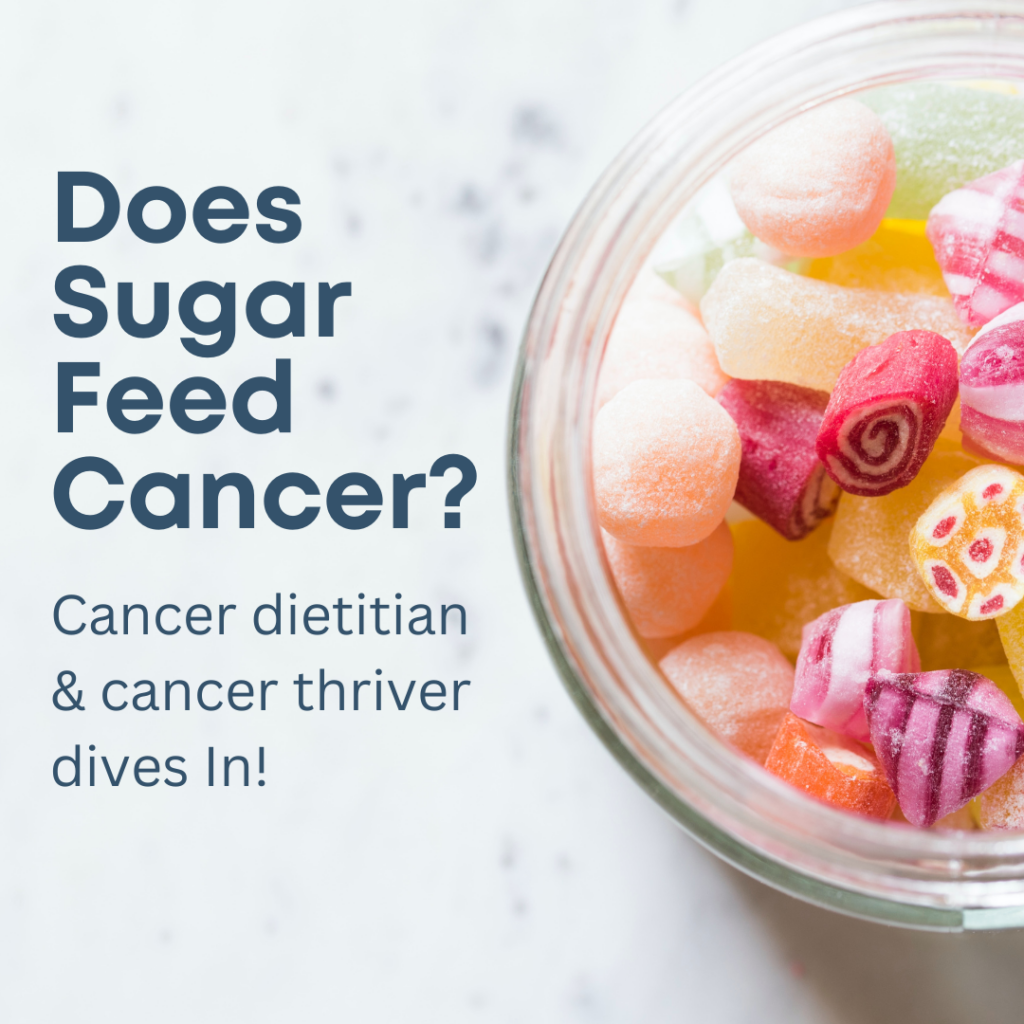
(And no — this doesn’t mean fruit is off-limits. The natural sugar in whole fruit comes wrapped in fiber and protective compounds, and fruit is firmly part of a risk-reducing pattern. If you’ve ever worried about that, I wrote a whole piece on it: “Does Sugar Feed Cancer?“)
The Honest Caveats of How to Reduce the Risk of Cancer — and There Are Real Ones
I can’t write a piece like this without being straight with you about what this evidence isn’t, because that’s how I’d want it given to me.
Almost all of it is observational. These studies show associations — patterns that travel together — not airtight proof of cause and effect. When researchers have run stronger randomized trials, the results have sometimes been humbler: Look AHEAD, again, didn’t show a significant cancer reduction from modest weight loss.⁴
Effect sizes for any single food are small. Most individual foods only shift risk by a little on their own — often somewhere around 5 to 15% (a relative risk in the 0.85–0.95 range).³ Real, but modest. The larger benefit comes from the whole pattern added up over time, which is exactly why I keep steering you toward pattern over perfection rather than any one hero food.
And it varies by person and situation. One recent analysis looked specifically at people who develop cancer young — and found that some of the usual risk factors still showed up (smoking, excess weight, and inactivity), but alcohol and diet didn’t show a clear link in that younger group.¹⁴ That doesn’t erase the broader evidence — it’s a reminder that these connections can look different from one group of people to the next, and that none of this is one-size-fits-all.
I share the caveats not to talk you out of any of this (obviously, I believe in the power of nutrition and lifestyle!) — the direction of the evidence is genuinely encouraging — but because content that only shows you the flattering half isn’t content you can trust. You deserve the whole picture so you can make your own informed choices.
What About After Treatment? How to Reduce the Risk of Cancer Recurrence
If you’re reading this from the other side of a diagnosis, here’s what I want you to hold onto: the major survivorship guidelines point survivors toward these same levers — plant-predominant eating, regular movement, limited alcohol, a healthy body weight.¹³ The controllables don’t change much when your goal shifts from lowering first-time risk to lowering the risk of recurrence. That’s oddly reassuring, isn’t it? It means the work you do here does double duty.
And speaking now not just as a dietitian but as someone who has sat in the infusion chair: in a season when so much felt out of my hands, these were the things I could put my hands on. Not as a guarantee. Not as a way to earn safety. But as a way to partner with my body and my care team, and to feel like an active participant in my own health again. That mattered more to me than any single statistic on this page.

Where to Start
If this feels like a lot, don’t try to do all of it. Pick the one lever that feels most within reach this week — maybe it’s a daily walk, maybe it’s swapping one sugary drink, maybe it’s adding beans to two dinners — and build from there. Consistent, imperfect progress beats a perfect plan you can’t sustain. Every time.
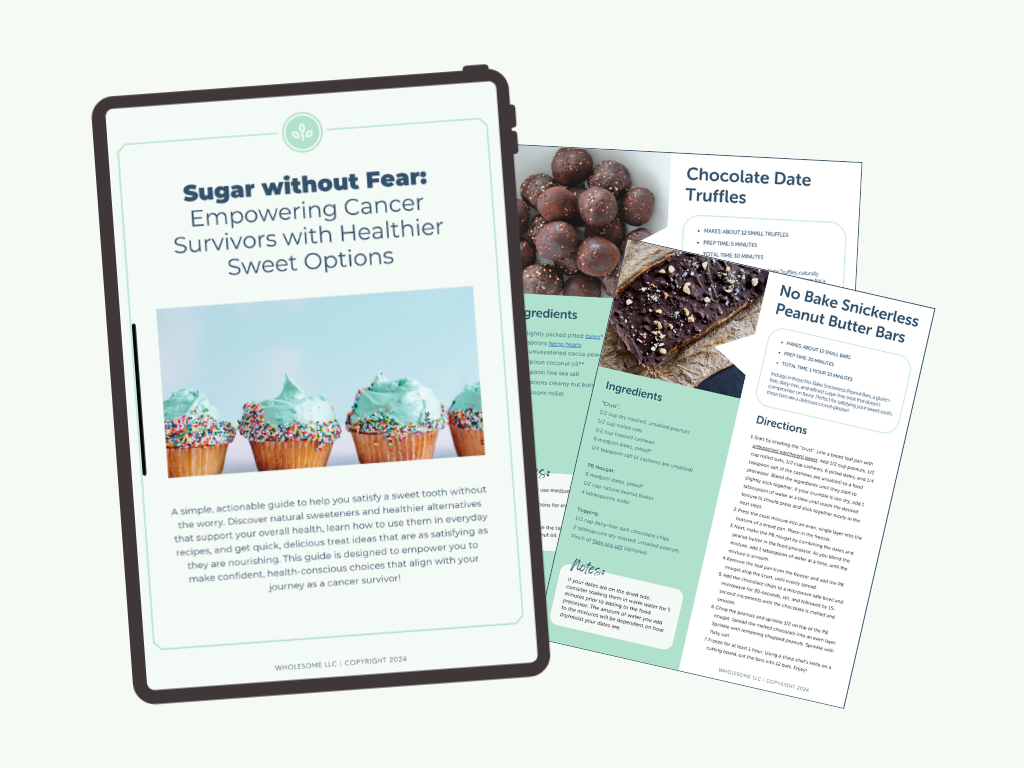
And if it’s the sugar question that’s been weighing on you — it’s one of the most common fears I hear, and one of the most misunderstood — I pulled together everything I want you to know in a free guide: Sugar Without Fear. It walks through what the science actually says, so you can stop second-guessing every bite and feel grounded in your choices instead of afraid of them. Grab the Sugar Without Fear guide here.
You don’t have to figure this out alone, and you don’t have to do it perfectly. You just have to start.
With you in this! 💪
In Good Health, Alison
By Alison Tierney, MS, RD, CSO — board-certified oncology dietitian and cancer survivor.
Last updated: August 2026.
References
- Fu J, Tan LJ, Lou S, et al. Association Between Adherence to Cancer Prevention Guidelines and Cancer Risk: A Comprehensive Systematic Review and Dose-Response Meta-Analysis of Cohort Studies. eClinicalMedicine. 2025;89:103569. https://doi.org/10.1016/j.eclinm.2025.103569
- American Cancer Society. Cancer Prevention & Early Detection Facts & Figures 2025–2026. Atlanta: American Cancer Society; 2025. https://www.cancer.org/research/cancer-facts-statistics/cancer-prevention-early-detection.html (confirm exact landing/PDF URL)
- Yin JL, Li YZ, Wang R, et al. Dietary Patterns and Risk of Multiple Cancers: Umbrella Review of Meta-Analyses of Prospective Cohort Studies. The American Journal of Clinical Nutrition. 2025;121(2):213–223. https://doi.org/10.1016/j.ajcnut.2024.11.020
- Shen S, Brown KA, Green AK, Iyengar NM. Obesity and Cancer: A Translational Science Review. JAMA. 2026;335(15):1341–1350. https://doi.org/10.1001/jama.2026.1114
- McTiernan A, Friedenreich CM, Katzmarzyk PT, et al. Physical Activity in Cancer Prevention and Survival: A Systematic Review. Medicine and Science in Sports and Exercise. 2019;51(6):1252–1261. https://doi.org/10.1249/MSS.0000000000001937
- Shreves AH, Small SR, Travis RC, Matthews CE, Doherty A. Dose-Response of Accelerometer-Measured Physical Activity, Step Count, and Cancer Risk in the UK Biobank. Lancet. 2023;402(Suppl 1):S83. (conference abstract — confirm direct DOI/link before publishing)
- Gapstur SM, Bouvard V, Nethan ST, et al. The IARC Perspective on Alcohol Reduction or Cessation and Cancer Risk. The New England Journal of Medicine. 2023;389(26):2486–2494. https://doi.org/10.1056/NEJMsr2306723
- Gapstur SM, Mariosa D, Neamtiu L, et al. The IARC Perspective on the Effects of Policies on Reducing Alcohol Consumption. The New England Journal of Medicine. 2025;392(17):1752–1759. https://doi.org/10.1056/NEJMsr2413289
- Rock CL, Thomson C, Gansler T, et al. American Cancer Society Guideline for Diet and Physical Activity for Cancer Prevention. CA: A Cancer Journal for Clinicians. 2020;70(4):245–271. https://doi.org/10.3322/caac.21591
- Yoo JE, Han K, Shin DW, et al. Association Between Changes in Alcohol Consumption and Cancer Risk. JAMA Network Open. 2022;5(8):e2228544. https://doi.org/10.1001/jamanetworkopen.2022.28544
- Behboudi-Gandevani S, Brustad IJ, Haugan T, et al. Alcohol Consumption Trajectories From Early Adulthood to Adulthood and Cancer Risk in Adulthood: A Systematic Review and Meta-Analysis. Cancer Epidemiology, Biomarkers & Prevention. 2026;35(6):824. https://aacrjournals.org/cebp (verified in CEBP 2026;35(6):824 — confirm exact article DOI/link)
- Brunello A, Nucci D, Veronese N, et al. Efficacy of Mediterranean Diet for the Primary Prevention of Oncological Diseases: A Systematic Review and Meta-Analysis. Nutrition. 2026;148:113131. https://doi.org/10.1016/j.nut.2026.113131
- National Comprehensive Cancer Network. NCCN Clinical Practice Guidelines in Oncology: Survivorship. 2026. https://www.nccn.org/guidelines (full guideline requires a free NCCN account; a free patient version is available at nccn.org/patients)
- Sala I, Botteri E, Berstad P, et al. Association Between Lifestyle and Risk of Early-Onset Cancer: Evidence From the European Prospective Investigation into Cancer and Nutrition and the UK Biobank. European Journal of Cancer. 2026;243:116869. https://doi.org/10.1016/j.ejca.2026.116869
Alison Tierney, MS, RD, CD, CSO
Alison is a registered dietitian, board-certified in oncology nutrition, and a cancer thriver. Her expertise in oncology nutrition and personal experience with her own cancer diagnosis and its treatment provide her with the unique perspective of being able to relate to her clients on an entirely different level. Her content is consistently focused on evidence-based guidelines and seeks to increase the awareness of the power of nutrition to complement traditional cancer therapies.
Leave a Reply
Featured Articles


This website provides educational information but it is not a substitute for medical advice from a licensed medical professional who is familiar with your particular facts and circumstances. The information contained on this website is not intended to diagnose, treat, or cure any disease and shall not be construed as medical advice. The information and education on this website is provided for you to use at your own discretion.
You can further review our disclaimer here.

Be the first to comment