
What do you want to learn more about?
Nourished through Treatment™
(Active Treatment Only)
The Signature VIP 1:1



Wow – it has been a few months since I’ve blogged here, or even added a recipe!
Things have been quite busy – as I’m sure they have been for you too.
I’ve been loving my individual coaching program, I am launching a group coaching program, and moving into a new office space. Lots of exciting things happening here at Wholesome!
I’ve also been loving up on some tofu lately! Concerned about tofu? Then you have to head over to my blog regarding “How Does Soy Affected Breast Cancer Risk?” Spoiler Alert: You do not need to avoid soy! In fact, it is protective against breast cancer and other hormonal-based cancers.
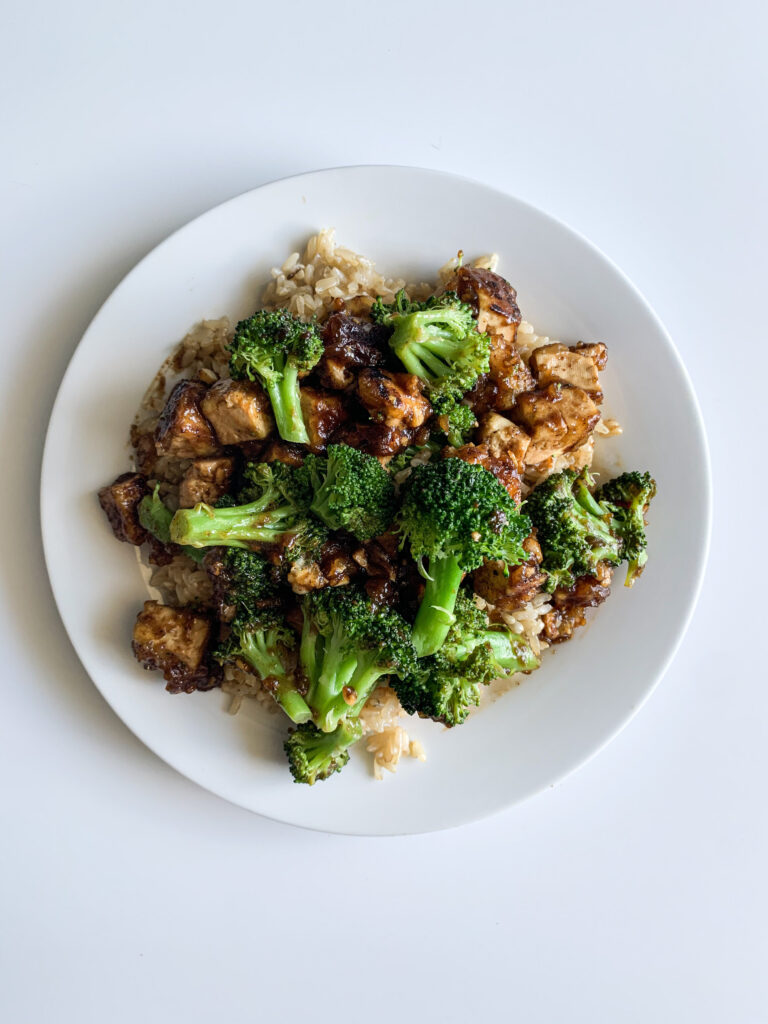
I came up with this recipe a few months ago and it is certainly my favorite go-to tofu recipe. It doesn’t require a lot of time or many perishable ingredients – making it perfect for a “a don’t feel like cooking and don’t have a lot of groceries” type meal.
Also, if you don’t care for spicy – this recipe is for you! (I am totally a baby when it comes to spicy). If you do care for spicy, add more cayenne and red chili flavors to increase the heat.
I’ve shared the recipe with some friends by taking a picture of my scrap envelope where I jotted down the recipe as I created it.
I thought it was about time to put it on paper, make the recipe make sense, and share it with all of you here!
Without further ado . . .
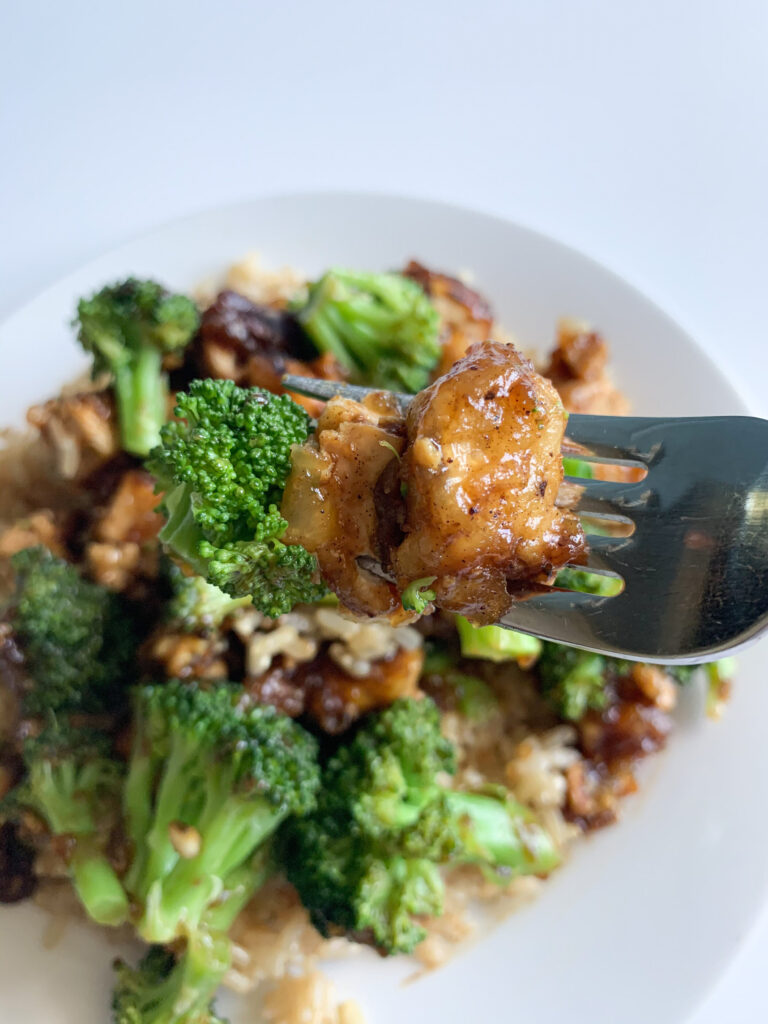
Kung Pao Tofu
Serves 3-4
Ingredients
Tofu:
1, 14 – 16 oz package organic, firm or extra firm tofu
1 tablespoon maple syrup
1 pinch cayenne pepper, or more for more heat
4 tablespoons cornstarch or arrowroot powder
1 tablespoon high heat oil (i.e. avocado oil)
Sauce:
1 tablespoon fresh, minced ginger root
2 cloves garlic, minced
1 pinch red chili flakes, or more for more heat
1 tablespoon rice vinegar
1 tablespoon toasted sesame oil
2 tablespoons coconut aminos (or, soy sauce/tamari)
1 tablespoon Hoisin sauce
1 teaspoon onion powder
1 tablespoon sugar
1 tablespoon cornstarch or arrowroot powder
¼ cup vegetable broth
4 cups broccoli florets (fresh or frozen)
1 ½ cups dry brown rice (or, 3 cups cooked brown rice)
Directions
Begin by preparing the tofu. Open the tofu package, drain, and press the tofu for 10-15 minutes. If you aren’t sure how to press tofu, here’s a quick video.
While the tofu is being pressed, if you need to make your rice – start it. I like to use an InstantPot to cook mine while I do the rest of the cooking.
Cut and wash the broccoli (if fresh). Prepare a large pot to steam the broccoli for about 5 minutes. Here is a quick video on how to steam broccoli. Once done, set aside.
When the tofu is pressed, cut into uniform cubes. Add to a mixing bowl. Drizzle with 1 tablespoon maple syrup and a pinch of cayenne pepper. Lightly toss. Next, add 4 tablespoons cornstarch and toss together. I like to use a rubber scraper to fold the tofu to help prevent it from crumbling.
Heat a large skillet to medium-high heat. Once hot, add 1 tablespoon high heat oil. Once the oil is hot, add the tofu into as even of a layer across the pan as possible. Allow the tofu to brown for about 4-5 minutes and flip tofu, aiming to brown all sides (if possible).
While the tofu is cooking, make the sauce.
In a small bowl, add the ginger, garlic, red chili flakes, rice vinegar, sesame oil, coconut aminos, hoisin sauce, onion powder, sugar, cornstarch, and ¼ cup vegetable broth/stock (water would do fine as well). Stir until well combined.
When the tofu is browned to your liking, add the sauce. Mix and gently coat the tofu with the sauce and cook for 3-4 minutes… The sauce should thicken a little as it heats. Feel free to add the cooked broccoli to the pan to add some sauce to the broccoli – or simply keep it on the side.
Serve tofu and broccoli over cooked brown rice.
Enjoy!

Alison Tierney, MS, RD, CD, CSO
Alison is a registered dietitian, board-certified in oncology nutrition, and a cancer thriver. Her expertise in oncology nutrition and personal experience with her own cancer diagnosis and its treatment provide her with the unique perspective of being able to relate to her clients on an entirely different level. Her content is consistently focused on evidence-based guidelines and seeks to increase the awareness of the power of nutrition to complement traditional cancer therapies.
Leave a Reply
Featured Articles
This website provides educational information but it is not a substitute for medical advice from a licensed medical professional who is familiar with your particular facts and circumstances. The information contained on this website is not intended to diagnose, treat, or cure any disease and shall not be construed as medical advice. The information and education on this website is provided for you to use at your own discretion.
You can further review our disclaimer here.

Hello, I’m confused about using oil. I understand the Nutrivention diet does not use oil? I’m trying to find recipes that I can use to lower my risk of cancer (still in the testing phase). There doesn’t seem to be a Nutrivention cookbook, or recipe booklet that I know of. I’m not sure if I can use oil, or not use oil in cooking, or just as a salad dressing. Can you clarify? Many thanks. Best, Connie
Hi Connie,
Thank you for your comment — great question. This is definitely an area with differing opinions in the plant-based nutrition space. I love Dr. Shah’s work, and I think these conversations are important and needed.
Nutrivention emphasizes a predominantly whole-food, plant-based pattern, with most fats coming from whole food sources like nuts, seeds, avocado, olives, and soy foods — which I’m a big advocate for.
That said, and as you mentioned, research consistently supports dietary patterns rich in whole plant foods — vegetables, fruits, legumes, whole grains, nuts, and seeds — for cancer prevention and survivorship. Ultimately, the overall dietary pattern matters most.
When it comes to oils, while I strongly believe healthy fats can absolutely come from whole food sources alone, I’m not personally opposed to small amounts of high-quality oils used intentionally. If using oils, I recommend prioritizing options like extra virgin olive oil or avocado oil over heavily refined oils, while also minimizing saturated fats where possible.
Personally, I think small amounts of oil can make plant-based eating more practical, sustainable, and enjoyable for some people — and that context matters, too.
So no, I don’t believe someone needs to fear a drizzle of EVOO on a salad or small amounts used in cooking. If someone prefers to be fully oil-free, that is certainly an option as well and one that I support. As an oncology dietitian and cancer survivor myself, I focus less on perfection and more on building meals around minimally processed plant foods consistently over time.
Hope that helps clarify things a bit! The research around this nuance simply isn’t fully black-and-white. 💛